
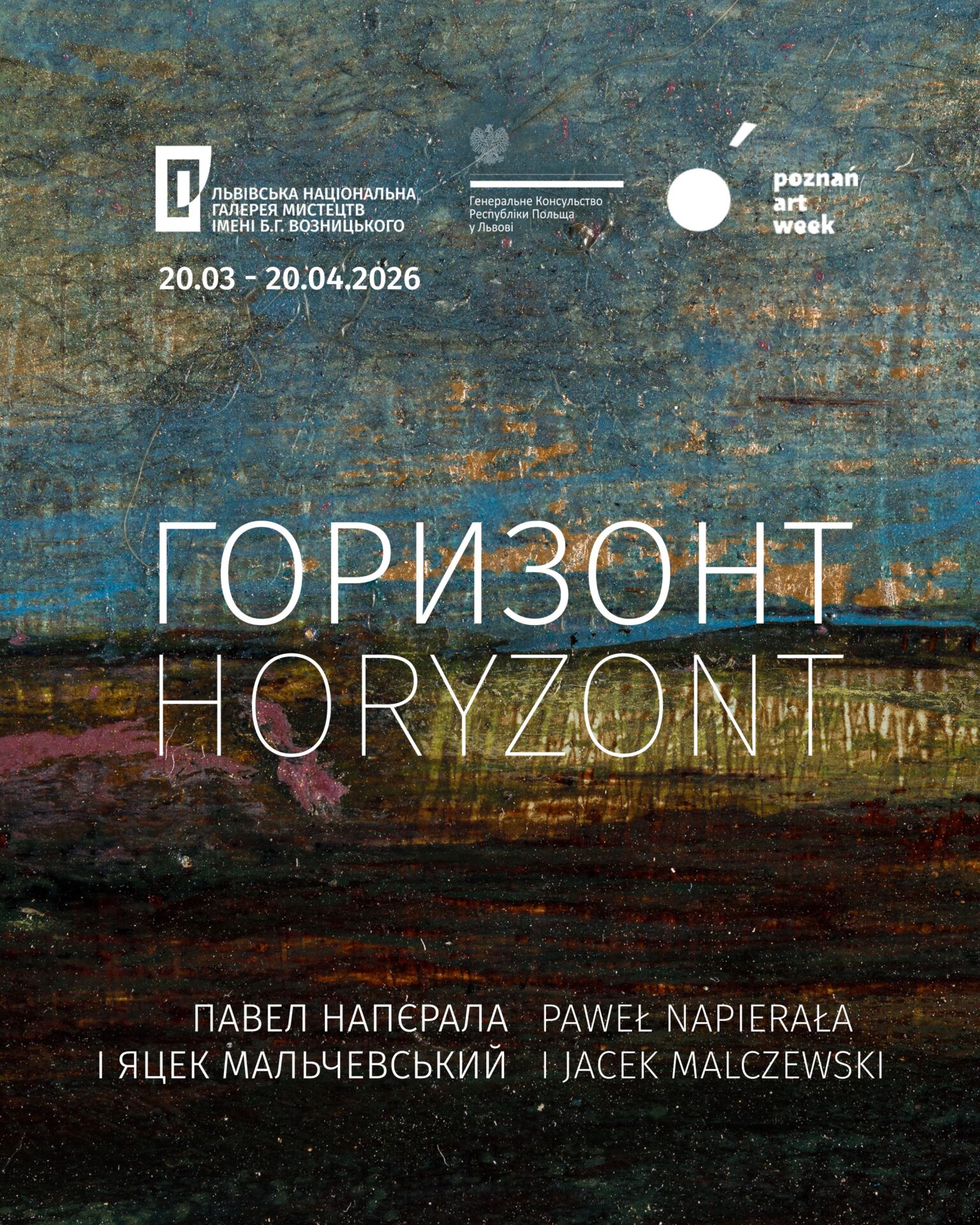
EXHIBITION: Horizon. Paweł Napierała and Jacek Malczewski
Honorary patronage:
The event is held under the honorary patronage of the Consul General of the Republic of Poland in Lviv, Dr. Marek Radziwon.
Landscape as a form of memory.
Miniatures by Paweł Napierała in dialogue with watercolors by Jacek Malczewski.
Again we wander through a warm land,
across the malachite meadow of the sea.
(…)
On violet-necked meadows
the sky stretches the fluidity of arcades.
The landscape softly seeps into the eyelids,
congealed salt on bare lips.
— Krzysztof Kamil Baczyński, Song, 1938
The verses of Krzysztof Kamil Baczyński, written in 1938, open up a space for a particular experience of landscape – not as a geographical location, but as a realm of desire, memory, and inner refuge. The poem, created on the eve of a historical catastrophe, is often interpreted as a record of tension between the real world and the imagined one—a space in which harmony is still possible. Landscape becomes here a figure of distance: not escape, but a shift in perspective that allows the preservation of contemplation.
Within a similar interpretative horizon, the exhibition presented at the Lviv National Art Gallery brings together miniature landscapes by Paweł Napierała and watercolors by Jacek Malczewski, created during the artist’s travels, including Rhodes and Adalia. The exhibition focuses on landscape understood not as a representation of specific topography, but as a form of recording inner experience – a construction of memory, perception, and reflection on the relationship between humans and the world.
Paweł Napierała’s landscapes are not created in direct contact with nature. The artist paints them from memory, treating the landscape as a mental image, devoid of clear geographical references. In this way, he creates a universal type of landscape – a synthesis of motifs and visual structures functioning within the collective imagination. These are recognizable images, yet impossible to place precisely; landscapes in which the viewer finds familiar elements that evoke individual memories and experiences. The landscape functions here as a projective space – a field where personal and cultural memory intersect.
The miniature format of Napierała’s works plays a significant role. This scale enforces an intimate mode of reception, slowing down the act of viewing and directing attention to color relations, compositional rhythm, and subtle tonal tensions. The landscape ceases to function as a view opening before the gaze; it becomes a space of focus and self-reflection – a record of the act of seeing itself.
Jacek Malczewski’s watercolors, created during his travels in the Mediterranean basin, including Rhodes and Adalia, present a different yet complementary way of experiencing landscape. Although connected to specific places, they do not serve a documentary function. The landscape is subordinated to the artist’s subjective perception, mood, and the interplay of light and color. It becomes a record of a moment of pause and contemplation – a suspension between real experience and its transformation into an image.
The juxtaposition of Napierała’s works with Malczewski’s watercolors does not aim at historical comparison or reconstruction of influences. Instead, it creates a space for dialogue between two ways of thinking about landscape as a medium of reflection – independent of narrative events and resistant to unambiguous meanings. In both cases, the landscape becomes a form of distance: it allows one to step away from the immediacy of events and direct attention toward what is enduring – the relationship between seeing and memory.
The location of the exhibition at the Lviv National Art Gallery introduces an additional interpretative dimension. In the context of a city with a strong historical presence, landscape reveals its potential as a space of long-duration thinking. It is not a response to current events nor their illustration; rather, it becomes an autonomous field of reflection in which art retains the ability to formulate questions that go beyond immediacy. Landscape – both in the miniatures of Paweł Napierała and in the watercolors of Jacek Malczewski – functions as a form of memory: not so much an image of the world as a way of experiencing and understanding it.
- Author: o.petrenko
- Published on: 23.03.2026, 12:23
- Last edit: 23.03.2026, 12:23